What a co-founder matching platform actually does
Choosing between a co-founder matching platform and your own network is one of those decisions that looks binary from the outside but rarely is in practice.
Both routes can work.
Both can waste months if you use them the wrong way.
The real question is not which channel is better, but which one fits your situation.
Consider how much relevant network you have, how clearly you can describe your needs, and how much time you can spend vetting strangers.
This guide walks through how each route actually works, what each is good at, where each falls short, and how to combine them without doubling your workload.
By the end you should be able to point at your own situation and say which route you will start with this week.
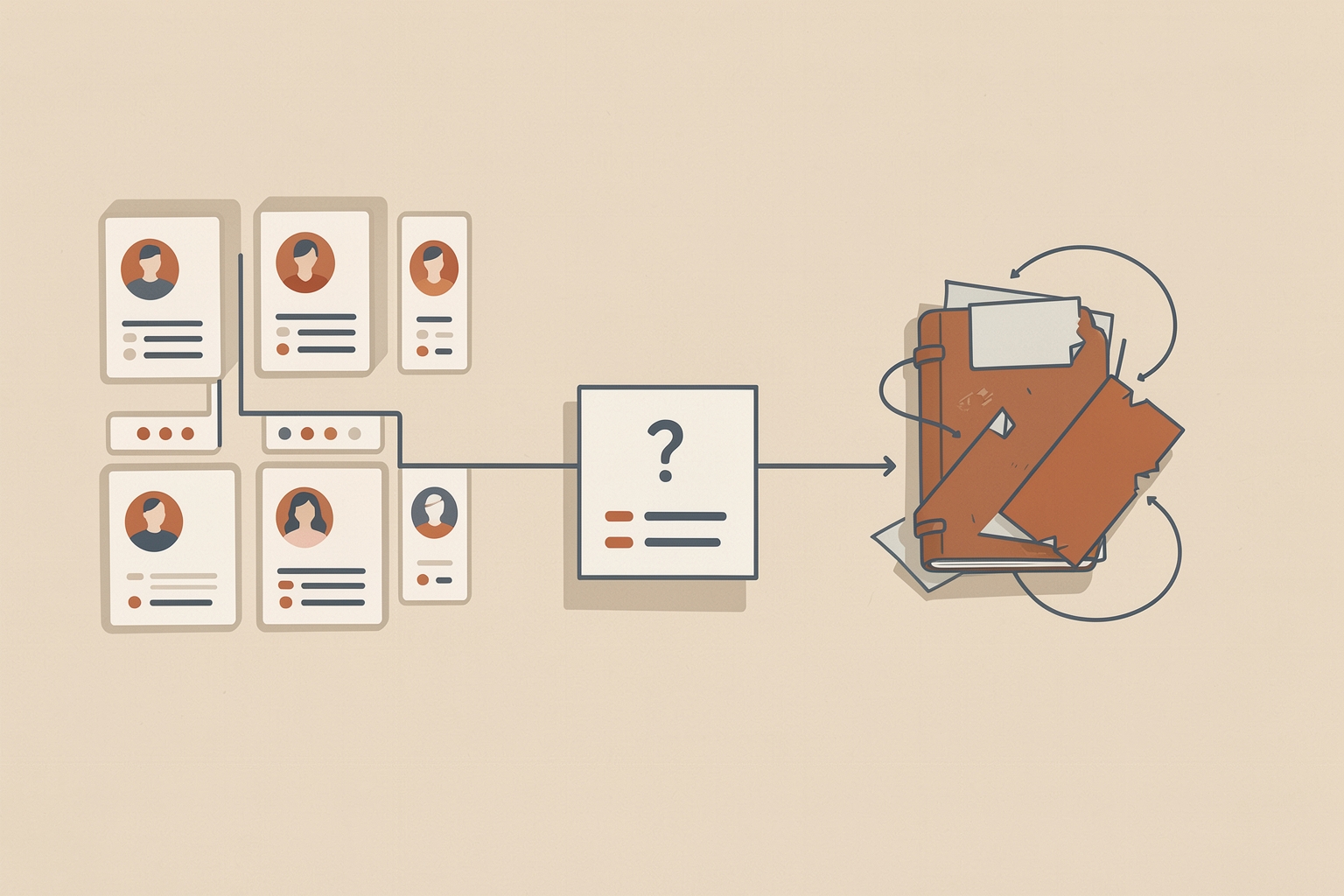
A co-founder matching platform is, at its core, a structured introduction service.
You create a profile describing your skills, interests, location, and what you want in a partner.
The platform shows you candidate profiles, you reach out to people who look promising, and if they accept, you are matched.
Y Combinator describes its own platform this way and openly compares it to online dating, noting that a match is only the beginning of the process, not the end Y Combinator.
That comparison is more useful than it sounds.
Nobody expects to marry someone after one date.
YC explicitly encourages matched founders to work together on a time-boxed trial project with clear expectations before committing Y Combinator.
So the honest framing is this: a platform solves the discovery problem.
It does not solve the trust problem.
You still have to do the work of figuring out whether you can build with this person for years.
The advantage of platforms is reach.
If you are a student, a freelancer, or someone whose professional circle does not overlap with startup building, your network may simply not contain the person you need.
A platform puts you in front of people actively looking, which removes the awkwardness of asking acquaintances whether they know anyone.
Everyone on the platform has opted in to the same search you are on.
What your own network actually offers
Your network works differently.
It rarely hands you a finished co-founder on demand.
What it gives you instead is context: shared history, reputational information, and people who can vouch for each other.
When someone you have known for years suggests a collaborator, you inherit some of that trust for free.
The catch is that most people overestimate how much relevant network they have.
Knowing a hundred people is not the same as knowing people who want to build what you want to build, at the time you want to build it, with the skills you lack.
If your network is full of classmates, former colleagues, and family, the honest answer may be that it contains zero viable co-founder candidates right now.
That is not a failure.
It just means the network route needs a building phase before it produces results.
There is also a subtle risk on this side.
Co-founding with a friend feels safe because you know each other, but friendship answers a different question than working compatibility.
You may like this person and still not know how they behave under deadline pressure.
You also may not know how they handle disagreement about direction, or whether they follow through on unglamorous work.
The vetting work is the same whether you met at a platform or at a wedding.
The decision factors that actually matter
Rather than asking which channel is better in the abstract, ask these questions about your own situation:
- Do you know what you need? If you can write one clear sentence about the skills, commitment level, and working style you are looking for, a platform works well because profiles are searchable. If you cannot describe it yet, conversations inside your network will help you figure it out faster than scrolling profiles.
- Does your network overlap with the problem? If you are building a technical product and nobody in your circle writes code, the network route starts from zero. If you are building something adjacent to your industry, your network may be the richest source available.
- How much time can you invest? Platform searching can be fast to start but slow to convert, because every match needs vetting from scratch. Network conversations are slower to start but each one carries more context.
- How do you handle rejection and awkwardness? Asking friends for introductions means people know you are looking. On a platform, everyone is looking, so the social cost of a failed conversation is lower.
Notice that none of these questions produces a universal answer.
A first-time student founder with a small circle and a clear idea is in a different position than an industry veteran with a large but misaligned network.
A practical way to run both routes
The strongest approach for most people is not choosing once and forever.
It is running a small, structured effort on both fronts and letting evidence decide where to invest more.
Start by writing your one-sentence description of the co-founder you need.
This is useful regardless of channel, because it forces you to admit whether you are looking for a specific skill, a specific commitment, or just company on a lonely project.
Then do two things in parallel:
- Make a short list of network candidates. Not everyone you know, just the handful of people who plausibly fit your description. Reach out with a specific, low-pressure ask: a conversation about the idea, not a proposal to co-found.
- Create a platform profile that shows evidence. Treat your profile like a work sample, not a dating ad. Describe what you have built, what you are working on now, and what you bring to a partnership.
On the evidence point, public work profiles matter more than most founders realize.
GitHub lets you present your contributions, pinned projects, and a profile README explaining your work and interests to strangers GitHub Docs.
A stranger on a matching platform has far less to go on than one evaluating your GitHub profile.
Linking verifiable work from your platform profile closes that gap.
The same logic applies to any portfolio, writing, or shipped project you can point to.
Whichever route produces a promising candidate, the next step is identical: a trial collaboration.
YC recommends matched founders work on a time-boxed project with clear expectations before committing Y Combinator.
The same advice protects network-sourced partnerships.
A trial project converts vague enthusiasm into observable behavior.
You learn how the person communicates, decides, and delivers when nobody is watching.
Common mistakes on each route
On platforms, the most common mistake is treating a match as a decision.
A match is an introduction.
People who message a few candidates and then feel discouraged when conversations fizzle are usually skipping the trial-project stage, where actual compatibility gets tested.
The second mistake is a thin profile.
If your profile says only that you are looking for a technical co-founder, you are asking strangers to take a risk on someone they know nothing about.
On the network side, the most common mistake is the vague broadcast: telling everyone you are looking for a co-founder and hoping something turns up.
Specific asks get specific help.
Saying you need someone with backend experience who can commit evenings for a trial project gives your contacts something actionable.
The second mistake is defaulting to the most available person rather than the most suitable one.
Proximity is not compatibility, and unwinding a co-founder relationship that started on convenience is far harder than declining one extra coffee meeting.
How to know it is working
Give each route a fair run, then evaluate with simple signals rather than feelings:
- Are you having conversations with people who fit the description you wrote, or are you settling for whoever responds?
- Have any conversations progressed to a concrete trial project, or do they stall after introductions?
- Is your own profile and evidence getting stronger over time, so each new conversation starts from a better position?
If the platform produces conversations but no trials, the bottleneck is your vetting process or your profile.
If the network produces sympathy but no candidates, the bottleneck is reach, and that is exactly the gap platforms exist to fill.
If both stall, the bottleneck is usually the idea or the commitment level, and no channel fixes that.
Where to go next
Once you have candidates from either route, the questions you ask before committing become the critical skill.
Our guide on questions to ask a potential co-founder before you commit covers that conversation in depth.
If your network is thin and you want to build it deliberately rather than search it, read how to build a network without networking.
And if you are starting entirely from scratch online, how to find opportunities online without a big network maps the terrain.
For the underlying vocabulary, the co-founder glossary entry is a quick reference.
The short version: platforms solve reach, networks solve context, and neither solves commitment.
Write down what you need, show evidence of your work, and run both routes in parallel for a defined period.
Let a time-boxed trial project, not a good conversation, make the final call.
Take the next step with Ideoreto. Use the ideas in this guide as a starting point for your next project.
Register for Ideoreto to get started.