Key Takeaways
Working sessions beat passive brainstorming because they move ideas toward decisions and artifacts. Brainstorming can generate options, but a working session turns options into something a team can use.
Miro facilitation resources show that ideation works better with structure, activities, and participation. Atlassian's GSD session framing adds the missing piece: do work together, not only discuss work together.
Ideoreto can turn community brainstorming into execution by moving from comments and ideas into scoped sessions, contributor tasks, paid roles, and project updates.
That progression is important because communities often have plenty of ideas and not enough conversion. The working session is the conversion step: it chooses, scopes, assigns, and publishes. It respects creativity, but it also gives creativity somewhere useful to go. The best ideas earn their next test.
For key takeaways, the practical move is to turn passive brainstorming into something visible: a post, example, scoped task, profile proof, or working-session note that helps someone understand Working Sessions Beat Passive Brainstorming faster.
For key takeaways, the practical move is to turn brainstorming alternatives into something visible: a post, example, scoped task, profile proof, or working-session note that helps someone understand Working Sessions Beat Passive Brainstorming faster.
- Brainstorming generates options
- Working sessions turn options into output
- Structure makes creativity more useful
- Ideoreto connects ideas to contributors and roles
- The best sessions end with a next action
The Problem With Passive Brainstorming
Passive brainstorming feels productive because ideas are appearing. But if nobody chooses, scopes, tests, assigns, or builds anything, the ideas remain an interesting list instead of becoming progress.
The problem is not brainstorming itself. The problem is stopping there. Ideas need a second stage where they become decisions, experiments, drafts, and tasks.
A working session provides that second stage and gives the group a practical path from imagination to action.
A useful example for the problem with passive brainstorming is not a perfect success story. It is a small visible loop: someone tries something, gets a response, improves the artifact, and leaves a trace other people can evaluate.
That loop is especially important for a remote team, creator group, or student project team. Without it, active collaboration stays abstract. With it, the reader can show progress even before they have a big credential, famous client, or polished launch.
For the problem with passive brainstorming, the practical move is to turn brainstorming alternatives into something visible: a post, example, scoped task, profile proof, or working-session note that helps someone understand Working Sessions Beat Passive Brainstorming faster.
What Active Collaboration Looks Like
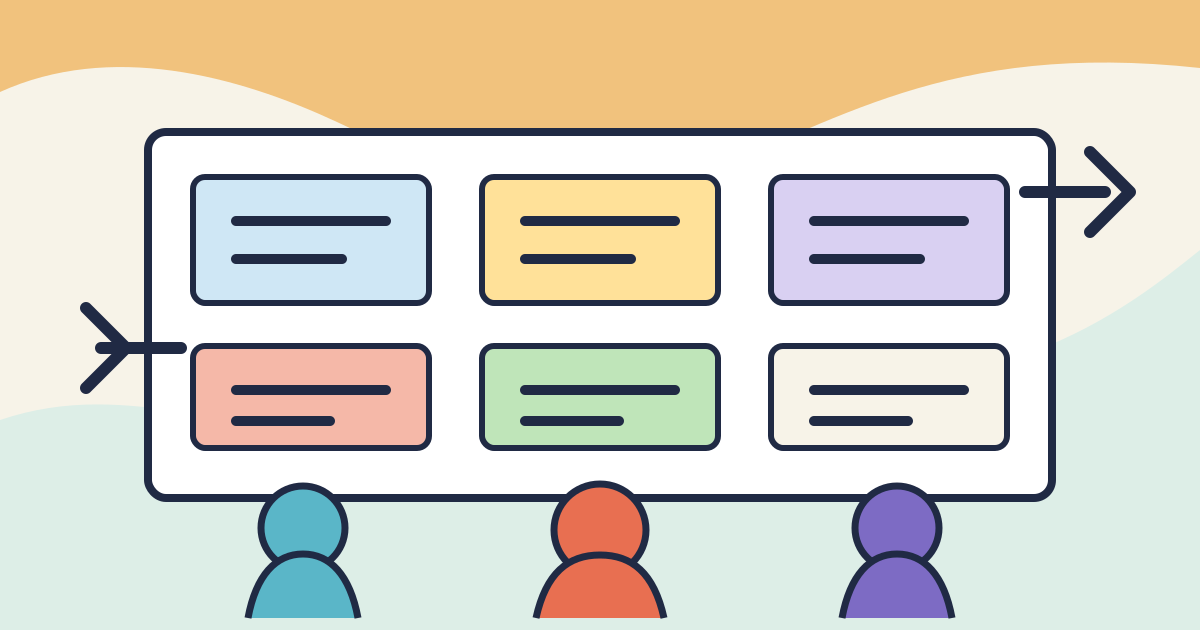
Active collaboration gives people a job inside the session. One person frames the problem. Others generate options. The group sorts, chooses, drafts, assigns, or tests. The session has movement.
Miro templates often use structured activities like voting, sorting, and visual exercises. Those patterns matter because they keep collaboration active instead of letting one person carry the entire conversation.
The output can be small. A ranked list, first draft, or next experiment is enough if it changes what the team does next.
For what active collaboration looks like, the practical move is to turn practical brainstorming into something visible: a post, example, scoped task, profile proof, or working-session note that helps someone understand Working Sessions Beat Passive Brainstorming faster.
How Ideoreto Turns Ideas Into Action
Ideoreto is built around the path from idea to opportunity. A wall post can spark feedback, but a working session can turn that feedback into a project brief, role list, research plan, or launch task.
Community members can move from spectators to contributors. A student can research the idea, a freelancer can shape the deliverable, a founder can decide priorities, and a creator can test the story.
That is why working sessions are such a natural fit for Ideoreto. They turn public interest into shared execution. People with different experience levels can contribute in different ways: one person collects examples, another writes options, another identifies risks, and another converts the chosen direction into a next task.
Picture this in practice: a vague meeting becomes a focused session with a goal, a shared artifact, and one owner for the next decision. That is the moment useful meetings becomes useful, because the person is no longer collecting advice; they are deciding what evidence to create next.
For how ideoreto turns ideas into action, the practical move is to turn passive brainstorming into something visible: a post, example, scoped task, profile proof, or working-session note that helps someone understand Working Sessions Beat Passive Brainstorming faster.
For how ideoreto turns ideas into action, the practical move is to turn brainstorming alternatives into something visible: a post, example, scoped task, profile proof, or working-session note that helps someone understand Working Sessions Beat Passive Brainstorming faster.
How To Upgrade a Brainstorm
Start with ideation, but reserve time for selection and action. After ideas are generated, choose the best one, define the first test, assign an owner, and decide how the result will be shared.
If you are using Ideoreto, post the chosen direction afterward. Invite contributors into the next step instead of leaving everyone with a screenshot of sticky notes and a vague sense of possibility.
Creativity becomes more valuable when it is connected to execution. Working sessions make that connection explicit.
For example, a community brainstorm about a new marketplace feature should not end with fifty ideas. It should end with one testable feature direction, three assumptions to validate, a student research task, a freelancer prototype brief, and a founder decision about what will be tried first.
The danger is collaboration that produces no decision or artifact. How To Upgrade a Brainstorm should help the reader notice that pattern early, while the cost is still small and the work can still be changed.
For how to upgrade a brainstorm, the practical move is to turn brainstorming alternatives into something visible: a post, example, scoped task, profile proof, or working-session note that helps someone understand Working Sessions Beat Passive Brainstorming faster.
A practical Ideoreto prompt for Working Sessions Beat Passive Brainstorming: "I am working on working session vs brainstorming. Here is the artifact I have so far, here is the question I need answered, and here is what I will change if the feedback is clear." That kind of prompt gives the community something useful to answer.
The strongest next step is usually small. For Why Working Sessions Beat Passive Brainstorming, it could be a post, profile update, project brief, validation question, internship task, or working-session agenda. The format matters less than the evidence it creates and the response it invites.
Use the article as a decision aid, not a saved tab. If idea execution matters to the reader, the next move should produce a trace: a comment, example, revised artifact, scoped task, or clearer offer that can be seen again later.
A practical Ideoreto prompt for Working Sessions Beat Passive Brainstorming: "I am working on useful meetings. Here is the artifact I have so far, here is the question I need answered, and here is what I will change if the feedback is clear." That kind of prompt gives the community something useful to answer.
The useful next move for passive brainstorming is small enough to do today: write the current claim, attach the best proof available, and ask Ideoreto members for the one response that would make the next decision clearer.
The useful next move for brainstorming alternatives is small enough to do today: write the current claim, attach the best proof available, and ask Ideoreto members for the one response that would make the next decision clearer.
The useful next move for turn ideas into action is small enough to do today: write the current claim, attach the best proof available, and ask Ideoreto members for the one response that would make the next decision clearer.
The useful next move for ideoreto idea execution is small enough to do today: write the current claim, attach the best proof available, and ask Ideoreto members for the one response that would make the next decision clearer.
The useful next move for collaborative execution is small enough to do today: write the current claim, attach the best proof available, and ask Ideoreto members for the one response that would make the next decision clearer.
The useful next move for working session vs brainstorming is small enough to do today: write the current claim, attach the best proof available, and ask Ideoreto members for the one response that would make the next decision clearer.
The useful next move for active collaboration is small enough to do today: write the current claim, attach the best proof available, and ask Ideoreto members for the one response that would make the next decision clearer.
The useful next move for idea execution is small enough to do today: write the current claim, attach the best proof available, and ask Ideoreto members for the one response that would make the next decision clearer.
The useful next move for useful meetings is small enough to do today: write the current claim, attach the best proof available, and ask Ideoreto members for the one response that would make the next decision clearer.
The useful next move for practical brainstorming is small enough to do today: write the current claim, attach the best proof available, and ask Ideoreto members for the one response that would make the next decision clearer.
- Generate ideas
- Choose one direction
- Define the first test
- Assign an owner
- Share the next step on Ideoreto