
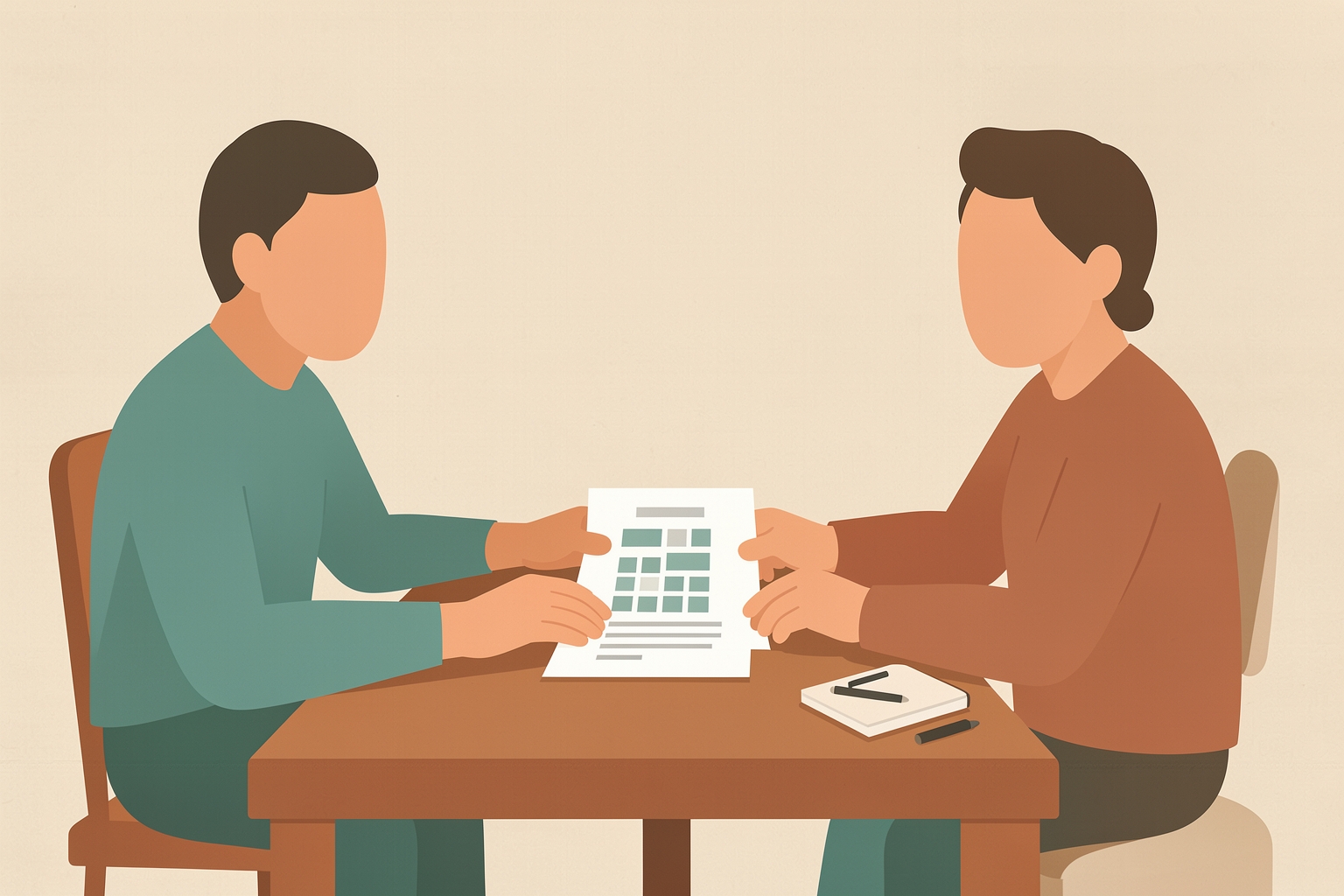
Why work evidence matters more than promises
Before two people commit to building something together, each one wants a reasonable answer to a simple question: can this person actually do the work, and will they keep doing it?
Talk is cheap, and everyone is charming in a first video call.
What separates a serious co-founder candidate from an enthusiastic stranger is evidence of real work.
This guide explains what to show a prospective co-founder before you both commit, and what to ask to see from them.
A co-founder relationship is closer to a marriage than a hire.
Y Combinator makes this comparison directly: like a romantic partner, a co-founder is someone you will depend on and spend a great deal of time with, hopefully for many years.
Their advice to matched founders is to work together on a time-boxed trial project with clear expectations and goals before committing Y Combinator on co-founder matching.
That framing has a practical consequence.
If you would not marry someone after one date, you should not merge your ambitions with someone after one conversation.
Evidence, not enthusiasm, is what lets both sides judge compatibility.
Evidence comes in two broad forms: things you have already built, and things you build together on a small scale before committing.
What to show: your existing proof of work
Start with what you already have.
You do not need a finished company or a polished product.
You need artifacts that show how you think, what you finish, and how you work with others.
Work samples and finished artifacts
Show the actual thing, not a description of the thing.
Depending on your field, that might be:
- A working prototype, even an ugly one, that demonstrates the core idea.
- A written analysis, plan, or research memo that shows how you break down a problem.
- Design files, landing pages, scripts, datasets, or customer notes from a past project.
- A volunteer or community project you carried through to completion.
The strongest samples are ones you can walk through end to end: what you set out to do, what you actually did, what went wrong, and what you changed.
A candidate who can narrate their own failures honestly is usually a safer bet than one who only shows highlights.
A public profile that backs up your story
If your work lives on a platform like GitHub, your profile can do a lot of the talking for you.
GitHub profiles showcase your work, contributions, and the information you choose to share publicly GitHub profile documentation.
This includes a customizable profile README at the top of the page, where you can describe your work and highlight contributions you are proud of.
The contribution graph and activity timeline add another layer.
GitHub profiles can display pinned repositories and a graph of contributions over the past year GitHub contributions documentation.
They also show a detailed timeline of commits, pull requests, and issues.
For a prospective co-founder, that timeline answers questions a resume cannot: do you ship steadily, do you collaborate, do you finish what you start?
You do not need to be a developer for this principle to apply.
A public portfolio, a writing archive, a community project log, or a documented side project all serve the same purpose.
The point is that a stranger can verify your claims without taking your word for it.
Context, not just artifacts
Raw samples can mislead.
A beautiful prototype says little about whether you can find customers; a pile of customer interviews says little about whether you can build.
When you present your evidence, add context:
- What your role was, and what others contributed.
- What constraint you were working under, such as time, budget, or skill gaps.
- What happened after the artifact existed. Did anyone use it? What did you learn?
This is where the idea of founder evidence becomes useful: evidence is strongest when it is specific, verifiable, and connected to a real outcome or lesson, however small.
What to ask to see from them
Showing your own evidence is only half the exchange.
Ask the other person for the same categories of proof, and pay attention to how they respond.
Someone who deflects, overpromises, or only offers talk is giving you information too.
Reasonable requests include:
- Samples of past work with an honest account of their role.
- A public profile or portfolio they are willing to share.
- References or a way to verify a past collaboration, where appropriate.
- A small, concrete contribution to a trial project, made within an agreed timeframe.
Pair these requests with the deeper compatibility questions covered in questions to ask a potential co-founder before you commit.
Evidence shows capability; those conversations surface values, expectations, and working style.
The trial project: building evidence together
The most convincing evidence either of you can offer is shared work.
Y Combinator encourages matched founders to work together on a time-boxed trial project with clear expectations and goals in order to vet compatibility YC's trial project advice.
A trial project converts claims into observations.
Choosing the right trial
Keep it small and bounded.
The goal is not to launch a company; it is to see how the two of you handle decisions, deadlines, disagreement, and follow-through.
Guidance on choosing the right small project before you commit applies directly here: pick something real, completable, and relevant to what you might build together.
Good trial candidates include a working prototype of one feature, or a validated set of customer conversations with written findings.
Other options are a small public artifact such as a guide or tool, or a scoped volunteer or community task.
If you are unsure how to scope it, a structured approach like a short proof sprint keeps the commitment brief and the expectations explicit.
Setting expectations before you start
Before the trial begins, agree in plain language on:
- What each person will deliver, and by when.
- How you will make decisions when you disagree.
- How much time each of you can realistically commit.
- What happens at the end: you either continue the conversation toward committing, or you part ways without hard feelings.
Writing this down is not bureaucratic; it is part of the evidence.
How easily you two agree on expectations is itself a signal about the working relationship.
Reading the signals during the trial
During the trial, watch for patterns rather than single events:
- Follow-through. Do agreed tasks actually get done, or do they slip without explanation?
- Communication under friction. When something goes wrong, does the person surface it early or go quiet?
- Handling of disagreement. Can you two disagree about an approach and still move forward?
- Honesty about limits. Does the person say what they cannot do, or paper over gaps?
None of these observations requires a spreadsheet.
They require paying attention while you work, which is exactly what a trial project is for.
Common mistakes when presenting evidence
A few pitfalls show up repeatedly:
- Leading with vision instead of work. A compelling pitch is not evidence. Show something you made or did.
- Overclaiming past roles. If a co-founder later discovers you inflated your contribution, trust is damaged before you begin.
- Skipping the trial because the conversation feels great. Chemistry is necessary but not sufficient; YC explicitly warns against deciding after a single call YC's co-founder matching guidance.
- Presenting evidence with no context. Unexplained artifacts force the other person to guess, and guesses tend to be generous.
Do you need a business model first?
Some people delay co-founder conversations because the idea is not fully formed.
For evidence purposes, that delay is usually unnecessary.
A rough plan plus demonstrated follow-through beats a polished deck with no work behind it.
The fuller answer to whether you need a business model before finding a co-founder depends on your situation, but early proof of execution is rarely wasted.
A simple checklist before you both commit
Use this as a final pass before committing to each other:
- Each of you has shown at least one finished, verifiable piece of work.
- Each of you has explained your exact role and what others contributed.
- You have completed at least one small trial project together with agreed expectations.
- You have discussed how you handle disagreement, time commitment, and what happens if it does not work out.
- Both of you can describe, in one sentence, what the other person reliably does.
If you can check these off, you are committing based on observed behavior rather than promises, which is the best available foundation for a co-founder relationship.
If you cannot, that is not a failure; it is a signal to run one more small project or keep looking.
Turning evidence into your next step
Evidence compounds.
Every small finished project, public artifact, and documented collaboration becomes material you can show the next person.
That person might be a co-founder, a client, or a collaborator.
Commit to a co-founder the way you would want them to commit to you: on the basis of work you can both see, not words you both hope are true.
Take the next step with Ideoreto. Use the ideas in this guide as a starting point for your next project.
Register for Ideoreto to get started.